Drift vs Wade: By the Numbers
Comparing success rates for wade anglers vs drift boat anglers

April 2026

I've always coveted drift boats. The freedom to circumvent private land, and access all the good spots that lay across the other side of the river. Fortunately, despite my own lack of boat, I've been lucky enough to hitch a few rides downstream now and then.
As a wade angler, I'm repeatedly struck by how quickly good runs pass by from the casting deck. One good drift and we're moving on. Some days, there's just too much water to cover in order to reach the take out by dusk, so you prospect your ass off. Therefore, it's probably not surprising to think that the success rate for float fishing is lower than wade fishing. At least when you think about the success rate of any individual hole. A wade angler can work one piece of water over and over, but the float angler may only get a couple shots before moving on. It really comes down to who's rowing, and how much daylight you get. If you get tangled, you might have to pass by fishable water as you sort out your rig. On the flip side, the float angler gets more changes on fresh water, or unpressured fish.
So which is more productive? Or, how can we compare a good day's float vs. a productive wade outing?
Wade vs Float: By the Numbers
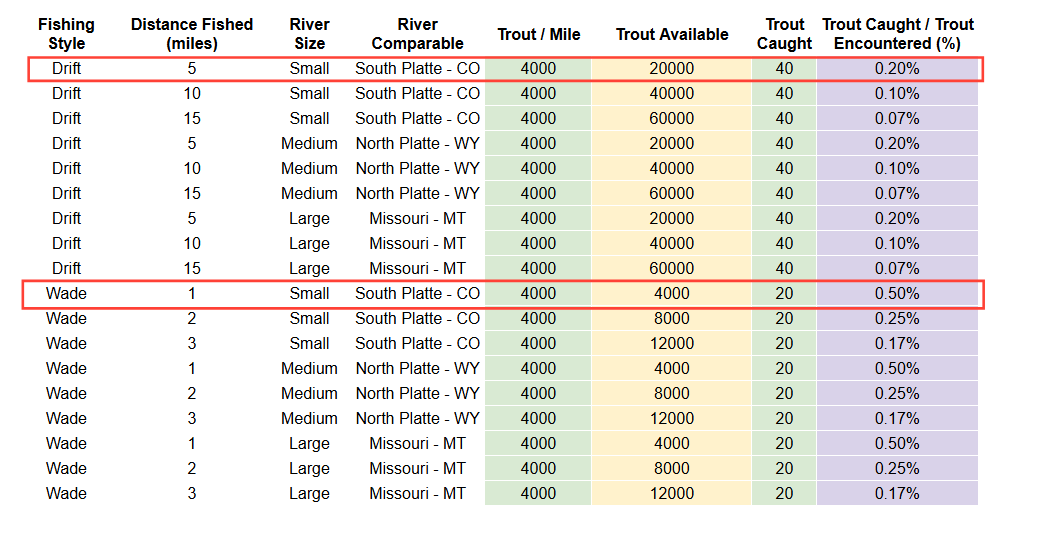
How many more fish do you need to catch from a boat to match the efficiency of wade angling? We can estimate how each method compares with some simple math. If you give yourself a pretty good day wade fishing, you might catch 20 fish. Maybe you walked 1 or 2 or 3 miles. We can compare these situations against common floats, maybe you cover 5 or 10 or 15 miles in a day. 20 fish on those floats still sounds great (to me), but even if you and your buddy in the back of the boat each catch 20, your falling short of the same outcome as a wade angler.
If you assume the trout per mile counts are consistent over the full stretch, then you can calculate the total number of trout available. Trout caught / trout available gives you a catch success rate: (trout caught / trout encountered)*100. 40 boat caught fish in a 5 mile float gives a lower success rate than 20 wade caught fish in 1 mile of hiking.
So, how many fish would the boat need to catch to match the efficiency of a 20 fish day on foot? Turns out it would be 100 fish netted by the boat.
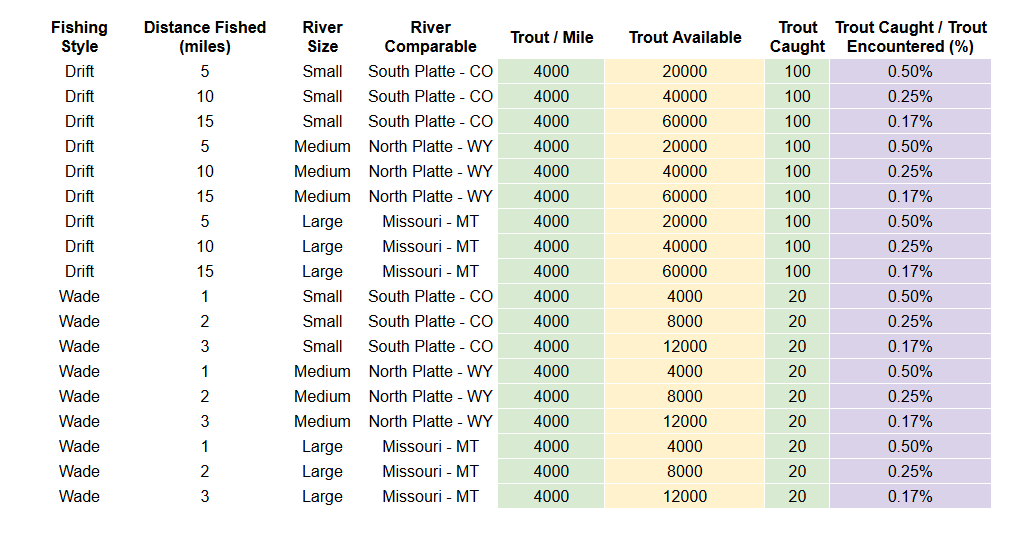
20 fish feels like a good day regardless of wade vs drift, that's just me. But in order to compare apples to apples, 20 wade fish is roughly equal to 50 drift fish in a boat of two equally successful anglers, assuming similar techniques were used in both settings over the same timeframe.
Of course this back-of-the-napkin math is generalized. Does that mean it's better to float shorter routes and prospect as you go, until you come up to promising holes where you get out and spend ample time wade fish? That maximizes the benefits of both methods. This approach might make sense for your average outing when chasing as many opportunities as possible. On the flip side, if I'm chasing a certain hatch like the salmonflies, or streamer fishing, then I'd want to float as much new water as possible.
Adjusting for River Size
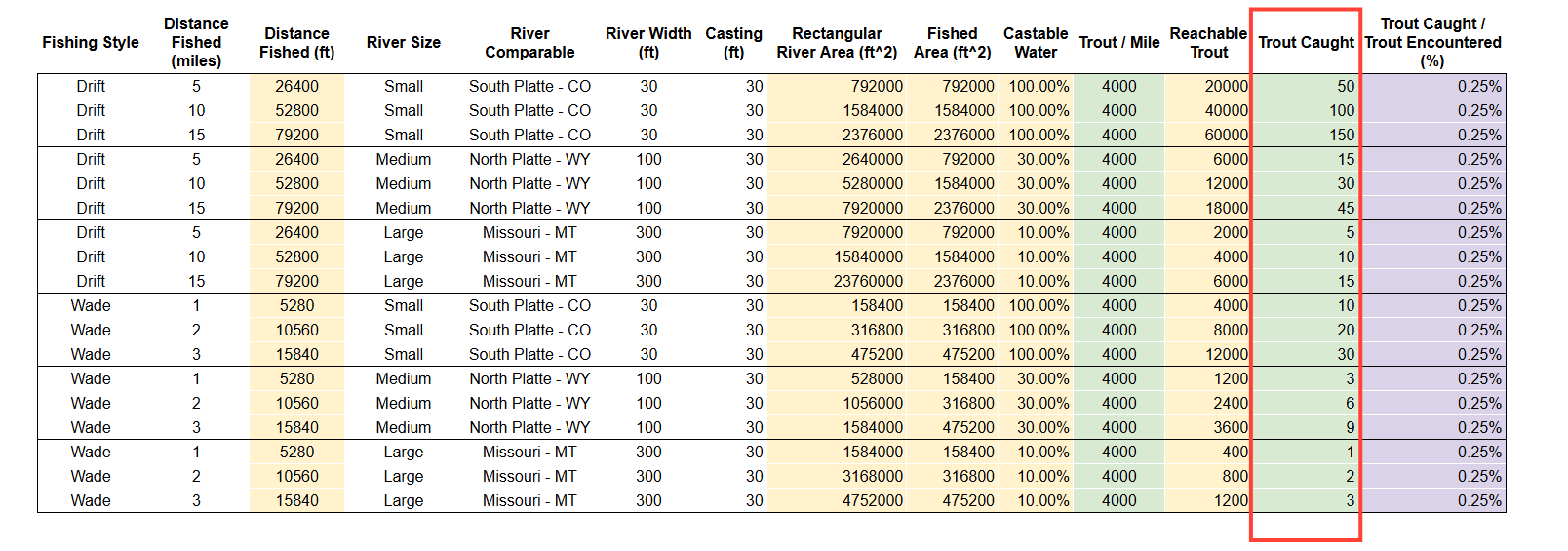
What is an equally successful day look like for small vs big, short hike vs long hike, short drift vs full day drift. Hard things to compare right? Until now... [evil laugh and lightning crackling in the background.]
On a massive 300 foot wide river, catching one trout wading over a one mile hike, is the consistent with catching 5 fish on a 5 mile float on the same river. That's intuitive. But how would that same success compare to a different sized river under similar circumstances? Broad strokes, but in 1 mile of wade fishing the massive Missouri River, catching 1 trout is roughly comparable to catching 15 trout on the North Platte during a 5 mile float. Again, broad strokes.... Still, a fun way to think about how to compare rivers. Almost like a unit conversion table.