
Spring Warmwater Primer
Where to find bass, pike and carp in spring on warmwater lakes
April 2026
I followed a wash down to the reservoir, clenching my teeth in an attempt to outpace the storming, darkening clouds. The scene was almost like the stereotypical cartoon fork in the road. Looking west, a brooding shallow sky, charged with electrical anger. East, a palette spanned sunset, rainbows and lollipops. Until this point, the day was characterized by hiking, staring, aimlessly wandering. I was itching with suspense. "Where were the fish?"... “They’re in the water!” I told myself sarcastically. But beyond that, I didn’t really know where to start. I had to make the right decision, the clock was ticking, and I needed a better plan.
This is a reminder to myself about where to start
It always seems easy on paper, but the bigger the lake, the harder to identify important hotspots, so let’s start at the beginning.
The Barry Reynold's master equation for finding warmwater gamefish:
- Structure + Cover + Forage
Easy right? Well I’m going to explain it to myself one more time, because it just doesn’t seem to stick. I can identify structures on small lakes, but sometimes on massive reservoirs, when bank fishing, I may only get the chance to pick one feature for the day. How do I pick wisely?
Structure is the hard stuff, the physical features. This includes, inlets, outlets, points, drop offs, reefs/humps, cover, rip-rap, even flats. This differs from cover, which can sometimes change.
Cover is the blanket that tucks fish in. Wind chop, fallen trees, docks, weedbeds, cloud cover, mudlines. When you have structure and cover, you are likely to have fish, even I know that Mr. Reynolds. Now we bring in the third addition, forage, and we should have enough to pull in bigger predators.
Forage always trips me up. The leading insights on forage in almost every text, is to research and match flies to the local offerings. Oh boy, why didn’t I think of that? But what does that mean? There are shad in the lake and every picture on the web shows a shad around 2 inches long. Then, next to the image, alongside the search results, an 8” streamer hanging out of the mouth of a large "shad" eating fish.

Either way, I’m confident I can make a few generalizations, categorize the baitfish offerings into colors to help eliminate unknowns. Here are some basic forage fish and their color profiles.
- Shad (silver or white)
- Perch (olive over yellow)
- Stocked Rainbow Trout (silver or white)
- Stocked Kokanee Salmon (silver or white)
- Bluegill (olive over yellow)
After reading Kevin Feenstra's Matching Warmwater Baitfish book, I'm realizing it's also important to prioritize soft-rayed baitfish as desired prey. Without spiny fins these fish are easier to eat, and if available, are probably preferred. The rule can be overwritten by abundance, if perch are the main prey, that's probably a better starting point.
Based on the above list, I’ll want white flies, silver flies, olive flies, and yellow flies. (Two-tone countershading is also important to consider at times.) That does help narrow it down. Especially when considering the overall mantra of applying sexy saltwater flare. So I’ll keep the flies straightforward with Clouser Minnows, Lefty’s Deceivers, Flashtail Whistlers, Seaducers, etc.. A Game Changer here, a Jungle Junky there, presto. But we’re missing black, purple, and chartreuse. Browns and oranges for crayfish too. Damn, so much for narrowing it down.
Fly size still confuses me, but any tier knows they can out effort these types of problems by spinning up a whole bunch of flies that’ll never get fished (just in case). Isn’t that the whole point of winter malaise?
—
There’s still one thing that would help me, a way to visualize all this on a map, across multiple interesting species. I’ll also need notes on important temperature checkpoints too, brb...
Here.
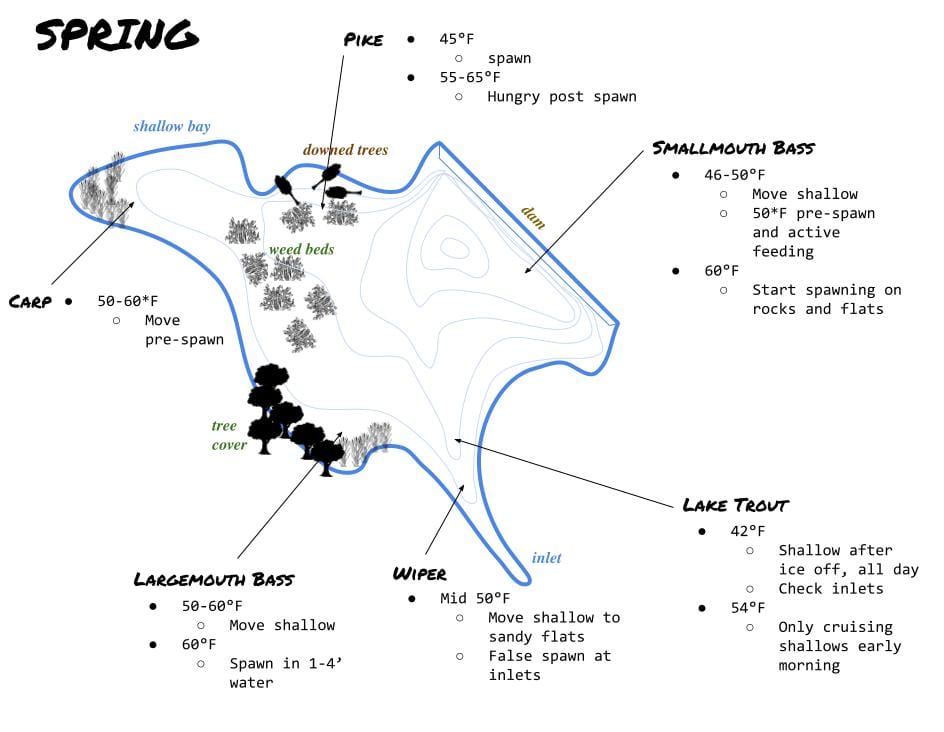
In a hypothetical lake where every species is present, first you’ll find opportunities for Lake Trout (an honorary species since it's rarely targeted on the fly), and pre-spawn Pike. Then Smallmouth move shallow and start feeding. Wipers run inlets and hunt shallow sand flats, matched by a move up gradient by Largemouth Bass. In the shallow areas you might find feeding carp the whole time, frankly they’re off doing their own thing anyway. If temperatures warm slowly, this is enough to keep me busy for months.
Enjoy this article? We need your help funding conservation and science reporting, fly fishing deep dives, and more stories from the road.
Every contribution helps support conservation and scientifically informed writing on fish.
What happens after we blast past these temperature checkpoints? Usually by then runoff is over, and any other fly angler running around warmwater lakes is a unicorn. Most are back on the rivers chasing trout and the iconic western hatches. Do I give up like the others? What’s the summer strategy? Oh I have a plan, but that will have to wait.
Further Reading
Biology: Learn About Warmwater Lake Ecology