
The Way We Think About Flooding is Out-Dated
Do you know what a 100 year flood really means?


August 2026
In 2022, a massive Montana flood impacted the Stillwater, Yellowstone, Flathead and Missouri Rivers, leading to evacuations, air lifts and massive erosion. Thanks to heavy rain falling on top of early spring snowmelt, a huge pulse of water overloaded the system. The flood was classified as a 500 year event, meaning it was estimated to have around 0.2% chance of occurring in any given year.
You'd expect that if a once in 500 year flood happens, risks might be lower for years to come, but that's not true. It's easy to misunderstand what hydrologists mean by a "500 year flood" or a "100 year flood," so let's start by exploring what those terms actually mean. Then we'll look at why the entire concept may be starting to break down.
Defining the 100 Year Flood
Bluntly, a 100 year flood doesn't mean a flood that happens once in 100 years. Instead, it's a statistical term describing a probability. A 100 year flood is an event with a 1% chance of occurring any given year. Just like rolling two independent 100 sided dice, there's a slim but real chance to get the same number twice. Likewise, a 100 year flood could happen two years in a row.
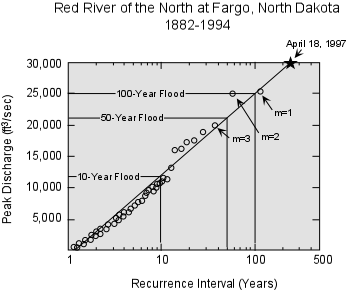
Hydrologists analyze factors like heavy rainfall, peak river flow, and even soil saturation using decades of historical data to estimate the probability of different flood events. By compiling all this data they can work out a relationship between flows and how often they occur. Below is an graphic example of flood intervals for the Red River in North Dakota.
The Model Is Out of Date
Now that we understand what a 100 year flood really means, we can explore how these models are starting to break down.
Over the past 20 years, researchers have discovered that global precipitation has increased, thanks to a pumped up hydrological cycle powered by increased global temperatures. Warmer air can hold more water vapor, fueling stronger storms, and more intense rainfall events. At the same time, rising temperatures are altering thermodynamics within the atmosphere, affecting circulation patterns, leading to more variability in precipitation. We may have more energetic water circulating, but it's not moving in ways we're used to.
These changes are throwing off how we make predictions about weather, and flooding is no exception. The assumptions that underpin labeling flooding events are beginning to break down. Floods that were historically considered "100 year events" may now occur more frequently than their estimated 1% annual probability suggests.
If our historical data is no longer representative of today's climate, then calculations used to predict flood risk may underestimate the likelihood of big events. The 100 year flood from the 1980's might effectively be today's 75 or 50 year flood.
So was that 2022 Montana flood really a 500 year event, or are the probabilities changing?
According to Robert Traver, Ph.D., P.E., BC.WRE, F.EWRI, F.ASCE, director of the Villanova Center for Resilient Water Systems,
"...We are beginning to understand that if the latest storm was the biggest you’ve ever seen, there’s probably another bigger one coming."
Enjoy this article? We need your help funding conservation and science communication, fly fishing deep dives, and more stories from the road.
Every contribution helps support conservation and scientifically informed writing on fish.
Further Reading
Explore the Conservation Concepts Series
How water heals: Rx Nature
Sources:
- Wikipedia. Accessed 2026. 2022 Montana floods. https://en.wikipedia.org/wiki/2022_Montana_floods
- National Park Service. 2023. Yellowstone Flooding: One Year Later. https://www.nps.gov/articles/000/yell-flooding.htm
- Earth Science Australia. Accessed 2026. Quantitative approach to floods and flooding. https://earthsci.org/processes/geopro/floods/floods_Gen/floods_flooding.html
- USGS. 2018. The 100 Year Flood. Water Science School. https://www.usgs.gov/water-science-school/science/100-year-flood
- Zhang, Y. Wang, K. 2023. Global precipitation system scale increased from 2001 to 2020. Journal of Hydrology. https://www.sciencedirect.com/science/article/abs/pii/S0022169422013385
- Zhang. W. Zhou, T. Wu, P. 2024. Anthropogenic amplification of precipitation variability over the past century. Science. https://www.science.org/doi/10.1126/science.adp0212
- American Society of Civil Engineers. 2024. With the 100-year flood model seemingly obsolete, what now? https://www.asce.org/publications-and-news/civil-engineering-source/article/2024/11/06/with-the-100-year-flood-model-seemingly-obsolete-what-now