
Conservation Concept: Artificial Boundaries and Their Impact on Rivers
Borders are everywhere. Not only natural but also artificial borders. The two don't always play nice...
February 2023
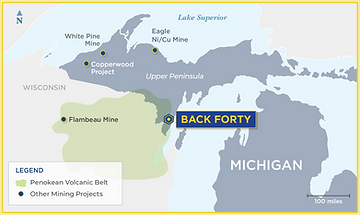
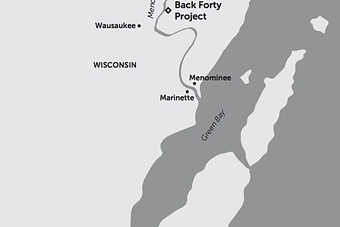
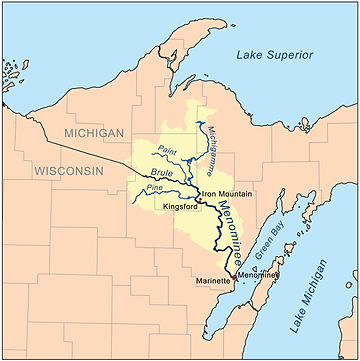
During a recent episode (Feb 2022) of the Orvis Fly Fishing podcast, Wisconsin's Menominee River, a renowned smallmouth bass river which borders Michigan's Upper Peninsula, was highlighted not only for its amazing fishery, but also for the impending risk of environmental degradation surrounding this hidden gem. This river is facing threats from a proposed, stream-adjacent, open pit sulfide mine that would drain heavy metals directly into the Menominee and further downstream into Lake Michigan. Sulfide mines produce gold and zinc, and though undoubtedly important for human development, are particularly tough on the health of rivers. Minerals leached from mine tailings, commonly referred to as acid mine drainage, negatively impact macroinvertebrates and the entire aquatic ecosystem when those contaminants make it into stream systems.
This issue, from an environmental perspective, is considered so dangerous to the river that the Menominee was ranked as the 6th most endangered river on the 2020 list of America's Most Endangered Rivers, citing these reasons: "mining and the habitat destruction and pollution that comes with it."
It's one thing to oppose the mine, and advocates in Wisconsin are gathering support to fend-off mine development and the potential for future mine development from the sale of mineral rights. But it's a whole different issue when the proposed mine isn't even being constructed in your state. This story has a twist...
The proposed mine would be constructed across the Wisconsin border in Michigan. Even if Wisconsin residents launched an effort to oppose the approval of this mine, jurisdictional approval depends on the decision made in Michigan.
To date, EPA hasn't granted all necessary permits, but this issue will linger. The initial mining company is already trying to sell its mineral rights to any potential buyers. If you want to support the fight to save the river, check out this site.
The reason I highlight this story is to discuss the issues surrounding environmental quality when crossing jurisdictional borders, such as states, counties, cities, even international borders. Once the water flows out of Michigan and into Wisconsin, the responsibility falls on Wisconsin to address those water quality problems. In some areas, states work together by developing specific watershed management plans to address the complex issues within their transboundary (ex: crossing state-lines) watersheds. Across the 50 United States, the majority of watersheds do not follow state lines and don't have specialized watershed plans when they do cross these boundaries. Once the water leaves the state, whoever is downstream is left to address any issues they inherit from their upstream neighbor. It's an externality from the upstream water user that must be paid for by those unlucky enough to be downstream.
So what happens to water quality when it crosses into a new state? Based on findings from Epperly et al. 2018, water crossing state lines is more likely to be impaired, as defined by the Clean Water Act. The reasons weren't geographic coincidences either; impairment most closely correlated with the number and type of land owner responsible for managing these areas.
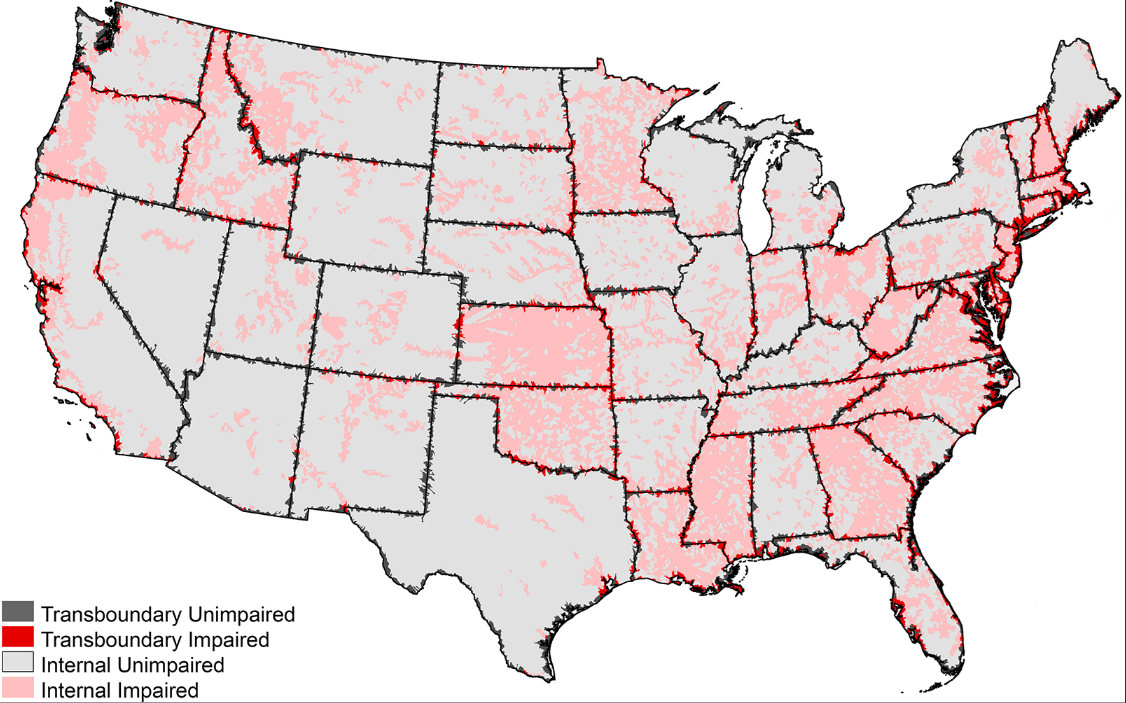
"Watersheds primarily consisting of public lands are less impaired than watersheds consisting of private lands. Similarly, watersheds primarily managed by federal agencies are less impaired than state-managed watersheds."
This work also adds credence to past observations claiming higher levels of pollution occurred upstream of borders in European nations, Brazilian counties, and Chinese provinces. Then you include the element of who is responsible for dealing with these issues. In a situation where various agencies are accountable, each agency's responsibility diminishes. Another quote from Epperly et al.:
"Agencies upstream of the border may feel less inclined to intervene when water pollution is transported out of their jurisdictions, while agencies downstream of the border may feel diminished responsibility if water pollution is entering from outside their jurisdictions."
Another theory is interagency gridlock: differences in goals between agencies lead to slowdowns in addressing these complex problems.
We Should Have Seen This Coming
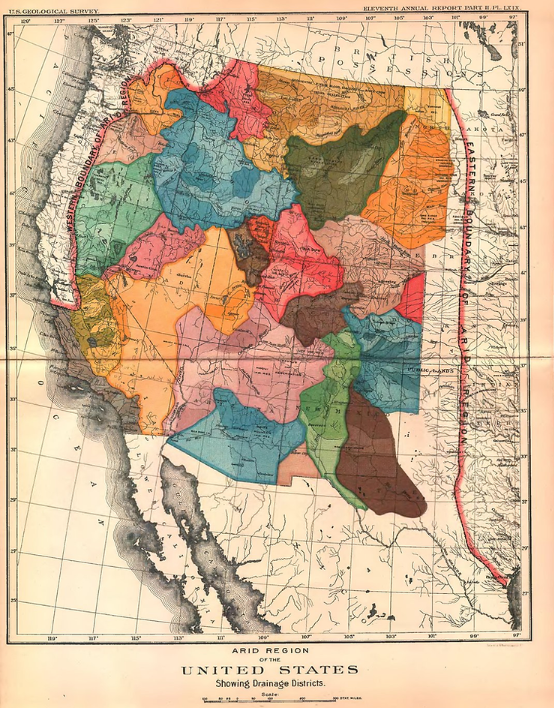
So it's clearly messy when dealing with water that crosses state borders...but this wasn't an unforeseen issue. Back in 1878, John Wesley Powell (head of the USGS at the time) advocated to create western state territorial boundaries based on watershed delineations. Meaning, each state would correspond to one large drainage basin, and the state would be holistically responsible for all waters flowing from headwaters to major rivers and streams.
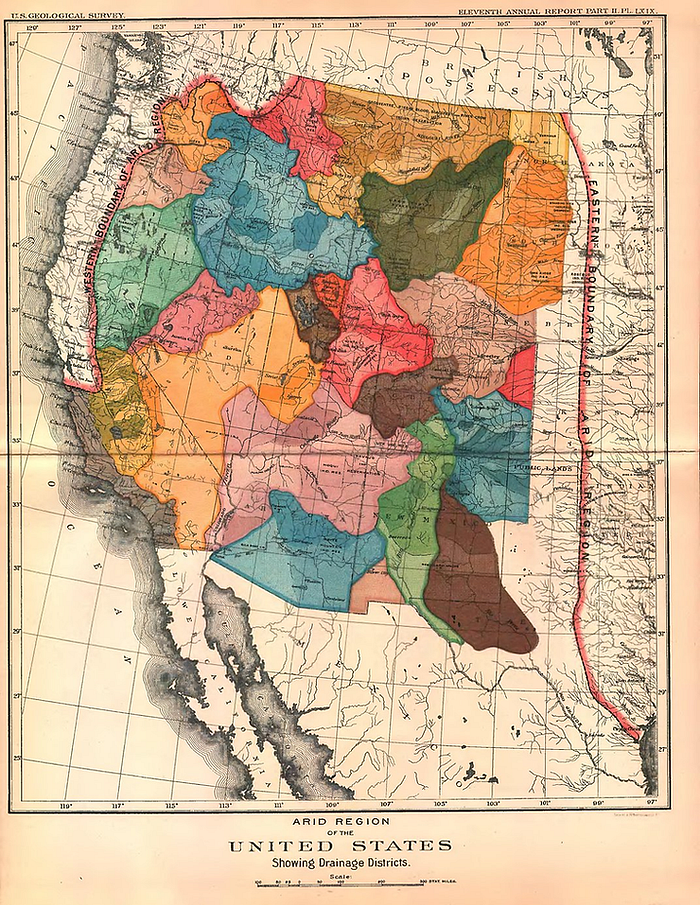
This concept was way ahead of its time, and only recently has the basin-wide approach again gained traction. Unfortunately, it only took the rest of us 140+ years of squabbling over water rights and natural resources to catch up.
Borders Are Everywhere
Though we specifically discussed this issue in relation to water quality management, these same problems occur across the natural landscapes with air pollution, marine protection, and any other system where jurisdictional boundaries don't match up with natural boundaries.
Back to the Menominee
Though clearly still in the developing stages with the Menominee River conflict, we see similar issues at play elsewhere involving (potentially impaired) waterways crossing state lines and the responsibility of one watershed split arbitrarily by various parties. Would the issue look different if the whole watershed was the responsibility of a single agency or state?

Sources:
- Rosenbauer, T. 2022. Modern Smallmouth Secrets, with Tim Landwehr. The Orvis Fly Fishing Podcast. https://podcasts.apple.com/us/podcast/modern-smallmouth-secrets-with-tim-landwehr/id278930814?i=1000547153314
- American Rivers. 2020. A Most Endangered Year. American Rivers. https://www.americanrivers.org/2020/04/a-most-endangered-year/
- Join the Coalition to Save the Menominee River, Inc. 2022. Save the River! https://jointherivercoalition.org/
- Price, M. 2022. Coalition to Save the Menominee River holds 2nd annual Water Celebration. Upper Michigan Source. https://www.uppermichiganssource.com/2022/07/24/coalition-save-menominee-river-holds-2nd-annual-water-celebration/
- Ross, J. F. 2018. The Visionary John Wesley Powell Had a Plan for Developing the West, But Nobody Listened. Smithsonian Magazine. https://www.smithsonianmag.com/smithsonian-institution/visionary-john-wesley-powell-had-plan-developing-west-nobody-listened-180969182/
- Epperly, J. et al. 2018. Relationships between borders, management agencies, and the likelihood of watershed impairment. PLOS ONE. https://journals.plos.org/plosone/article?id=10.1371/journal.pone.0204149
- Door County Pulse. 2018. Back Forty Mine Gets Final Approval. Door County Pulse. https://doorcountypulse.com/back-forty-mine-gets-final-approval/
- Gold Resource Corp. Back Forty Mine Michigan. https://goldresourcecorp.com/projects/back-forty-michigan-usa/history/
- Wikipedia. 2022. Map of the Menominee River wateshed - in Michigan & Wisconsin. https://en.wikipedia.org/wiki/Menominee_River#/media/File:Menomineerivermap.png
